For sales assistance
describe your needs
* Tell us about your project or requirements. For general inquiries, reach out to us at contact@seekall.net, and we'll get back to you promptly.

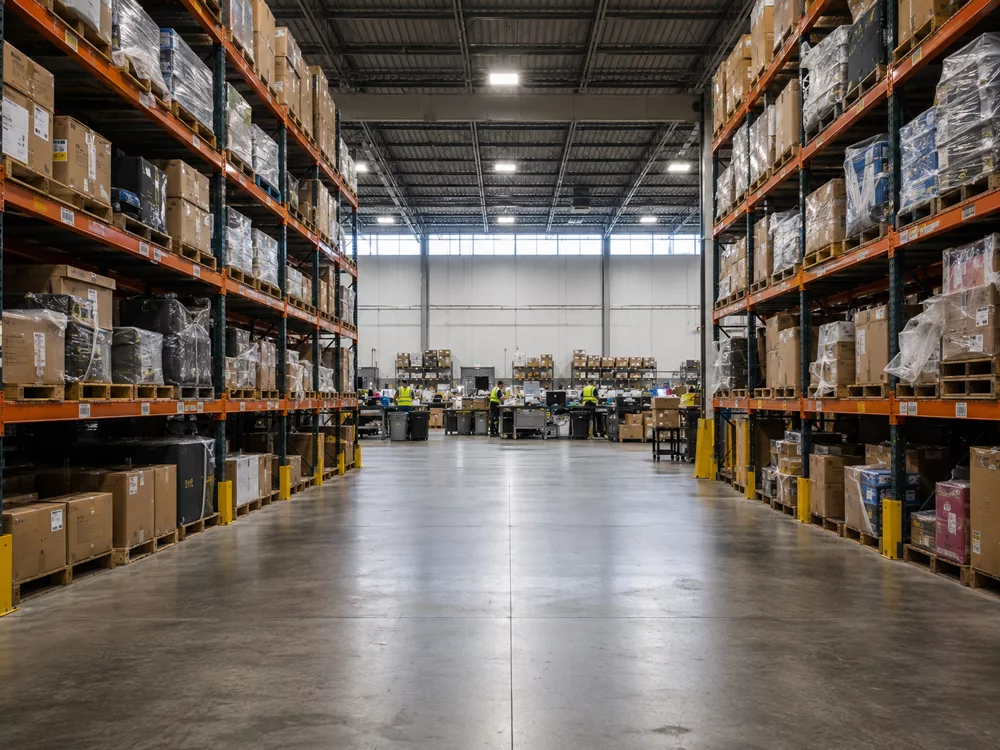
35,000 items daily. SSD-D readers with laptops scan shelf locations — full count in hours, not days.
A large returns center on the East Coast of the United States handles returns for multiple national retailers, processing over 35,000 returned items daily. The facility occupies approximately 50,000 square meters and stores merchandise across a wide range of categories — apparel, electronics, home goods, footwear, and more — with an extensive SKU count.
The operating logic of a returns center differs from a standard warehouse. Items do not arrive on a planned schedule; instead, they come in large volumes, in multiple batches, and without predictable patterns throughout the day. Each returned item must go through four stages: unpacking, inspection, sorting, and re-stocking. Once items are placed into inventory, they are distributed across thousands of locations on dozens of aisles, requiring regular counting and reconciliation.
The original counting process relied on workers walking the aisles and scanning barcodes one by one using handheld terminals. Given the variety of return categories and frequent location changes, a full inventory count took several days and required partial suspension of operations. Management realized that if counting could not keep up with the inflow of returns, inventory accuracy would continue to decline, ultimately affecting decisions on supplier chargebacks and resale.
The returns center faced four critical issues with inventory counting:
High SKU diversity, low counting efficiency – With many product categories and inconsistent barcode placements, scanning each item individually was extremely time-consuming. A full count took several days and had to be done in sections.
Frequent location changes – The storage locations of returned items changed often. Discrepancies between system records and actual locations accumulated over time, causing staff to spend excessive time searching for misplaced items.
Operational disruption during counts – Full counts required pausing receiving or picking in certain areas, affecting overall throughput. The returns center could not afford prolonged disruptions.
Data lag – After manual counting, data had to be entered into the system by hand, resulting in a lag of several days. Management could not obtain a real-time view of inventory status.
The returns center deployed a mobile counting system using SSD-D1AL desktop readers paired with laptops.
Deployment configuration:
SSD-D1AL desktop readers were connected to laptops via USB and mounted on small carts. Operators pushed the carts along the aisles, holding the readers toward the shelf locations and scanning layer by layer, reading both shelf tags and item tags. Data was uploaded to the inventory management system in real time via Wi-Fi.
How it works:
Key requirements for mobile counting in a returns center include portability, fast read capability, ease of use, and extended operation time. The SSD-D1AL was selected for the following reasons:
Compact and lightweight – At 180mm and only 0.3kg, it is easy to mount on a mobile cart and move through dozens of aisles without causing operator fatigue during extended use.
Plug-and-play – Powered and connected via USB to a laptop, it requires no external power source and is not constrained by outlet locations. Counting can start anywhere, at any time.
USB-HID keyboard emulation – Tag data is output directly as keyboard input to the counting software, requiring no custom integration or development. It works out of the box.
Impinj E710 / X3M1 chipset – Provides stable short-range read performance, reliably reading shelf tags and item tags in dense rack environments.
Three months after deployment, the returns center reported measurable improvements:
Full count time reduced from days to hours – For 5,000 locations, the count was reduced from 4 days to under 6 hours, without the need to divide the facility into sections.
Inventory accuracy improved to 99.8% – Real-time data comparison eliminated manual entry errors and location discrepancies. Management gained a reliable, up-to-date view of inventory for the first time.
No operational disruption during counts – While carts moved along aisles, other areas continued normal operations. The returns center no longer needed to pause receiving or picking for inventory counts.
Time spent locating items reduced – With system records updated in real time, staff no longer spent time searching for misplaced items. One operator reported that average search time dropped from 15 minutes to under 2 minutes.
Based on the success of this system, the returns center plans to purchase additional SSD-D1AL readers and increase counting frequency from once a month to twice a week, further improving inventory accuracy.
By deploying SSD-D1AL desktop readers with mobile carts, the East Coast returns center reduced full inventory count time from days to hours, improved inventory accuracy to 99.8%, and eliminated operational disruptions during counting. The solution was simple to deploy, easy to operate, and required minimal changes to existing systems. The returns center is now expanding its reader fleet to increase counting frequency and sustain accuracy gains.